Case Study

Easystay Hotel App

Transforming the budget hotel experience through strategic mobile design

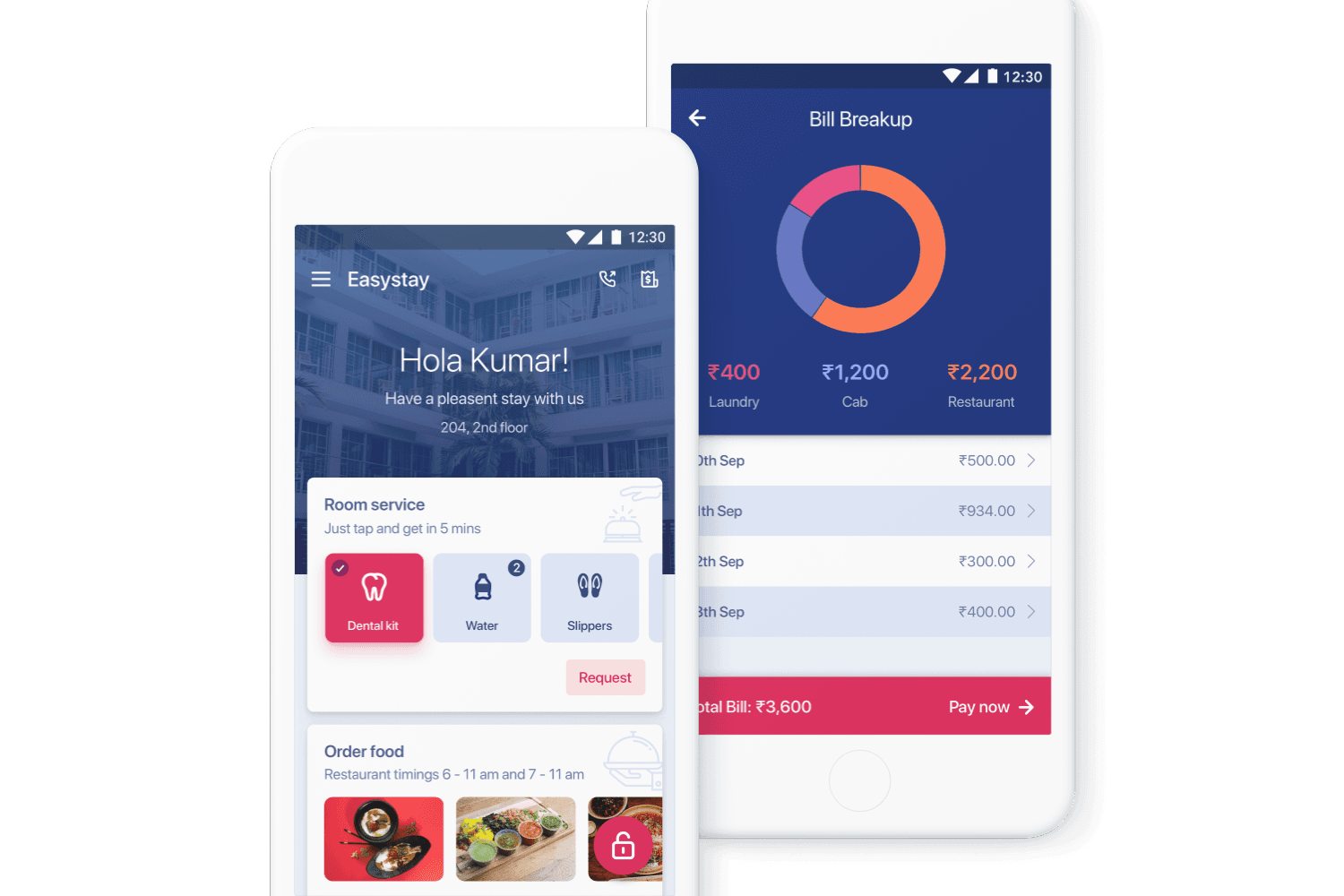
A comprehensive mobile application designed to address the systemic challenges budget hotel guests encounter during their stay. By leveraging the device guests always have with them, we created a unified platform that eliminates friction points and elevates the entire hospitality experience from check-in to check-out.

RoleUser Experience, User Interface, Visual Design
ToolsPen and Paper, Sketch App, Marvel (Prototype)
Target AudienceHotel Guests
Easystay Hotel App - Transforming the Budget Hotel Experience

Design Process

I follow a systematic approach to understanding user needs, defining solutions, and delivering exceptional experiences.

Discovery and Research

  • Define Problem
  • Objectives/Goals
  • Contextual Research
  • Persona

Ideation

  • Brainstorming/whiteboarding
  • Constraints
  • User flows

Design & Prototype

  • Wireframing
  • Visual design
  • Interaction design

Testing

  • User testing

Iteration

01

Discovery and Research

I explored user needs, market dynamics, and operational constraints through research and stakeholder conversations.

Project Scope

I designed this product for a chain of budget hotels, where operational efficiency and guest satisfaction directly impact profitability and brand reputation. Through market analysis, I found that budget hotels face unique constraints. They need innovative solutions to compete with premium experiences while staying cost-effective.

The Problem

Through user research and spending time in hotels, I discovered a fundamental disconnect between what guests expect and what budget hotels can actually deliver. Travelers face a fragmented experience. They're navigating transportation, waiting in long check-in lines, managing service requests through multiple channels, and trying to coordinate with staff across different communication methods. These friction points add up, creating unnecessary stress, eroding satisfaction, and hurting both the guest experience and the hotel's business.

Project Goal

My goal was to create a unified digital experience that brings all guest touchpoints into one intuitive interface. By consolidating transportation, check-in and check-out, and service requests, I could reduce operational overhead while dramatically improving guest satisfaction. The solution needed to be scalable, cost-effective, and deliver real improvements in both user experience and hotel operations.

The Solution

I designed a mobile platform that brings the entire guest journey into one cohesive experience. Since guests always have their smartphones with them, I built the solution around that device to eliminate friction at every touchpoint. With thoughtful information architecture and intuitive interactions, guests can manage transportation, check in, request services, track expenses, and check out all through a single interface that feels effortless.

I also built a parallel app for hotel staff because great guest experiences need great operations behind them. This companion product helps hotel teams manage guest requests, track service fulfillment, and maintain quality standards. It creates a symbiotic relationship where guest satisfaction and operational efficiency work together to drive real business value.

Important Note

This product is not intended for booking hotel rooms. Rather, it is designed for users who have already booked a hotel that offers services through this product. Upon booking, users will receive an SMS prompting them to download the application and use it starting from the check-in date.

User Story Development

After synthesizing insights from user interviews, observations, and behavioral analysis, I developed a set of user stories that mapped directly to pain points and opportunities. Each story was validated against research and prioritized by impact and feasibility. This ensured every feature in the final product addressed a real user need while also contributing to business goals.

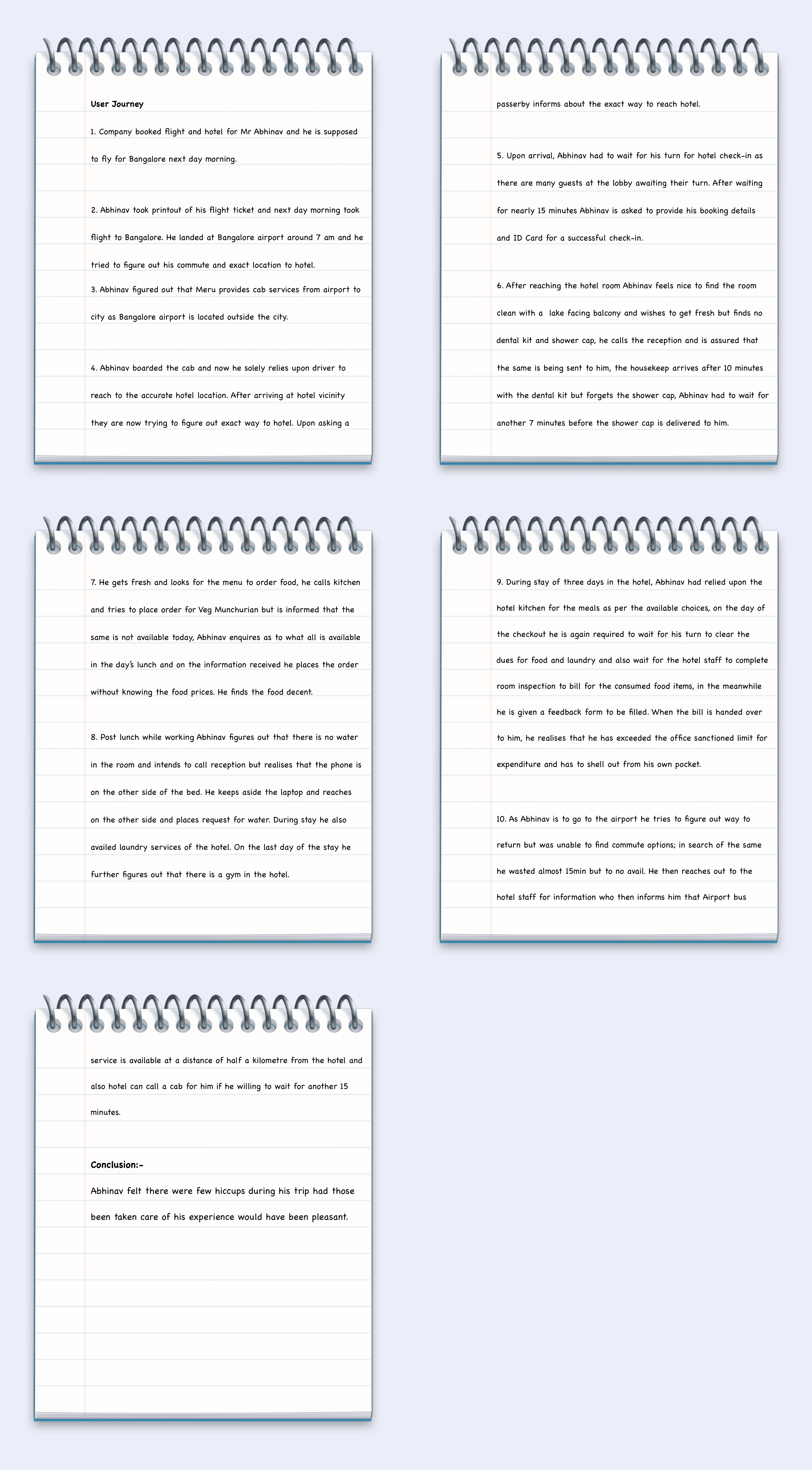
User Journey Mapping - Complete Guest Experience Flow
02

Ideation

I turned research insights into design solutions through ideation, user modeling, and solution architecture that balances user needs with business goals.

User Persona

While many different types of travelers stay in budget hotels, I focused on developing one deeply-researched persona that represented the highest-value user segment. This helped me make more precise design decisions and ensured core features addressed the most critical needs. The persona came from real interview data, behavioral patterns, and contextual insights, creating an authentic representation that guided every design choice.

AM

Abhinav Misra

Project Manager

Demographics

Age: 46yrs
Location: Gurgaon, India
Profession: Project Manager
Phone: Oneplus 3
Laptop: Lenovo, Windows OS
Trips: Mostly Professional
Avg Stay: 4-5 days

AAbout

Abhinav is a project manager in a service based IT company. His primary job is to manage client projects and meet clients to gather information about the project which is then passed to respective teams in his organisation. Due to his client facing job he is supposed to travel new places to new clients. He enjoys travelling and has been travelling from last 11years. His company often books travel and stay for him near client location, majorly in a budget hotel. He is a very sorted person and stays calm in most of the situation.

GNeeds and Goals

  • He believes that if budget hotels improve their internal communication, then they can be a less frustrating place to stay.
  • Simple check-in and check-out tasks can be improved in the hotel.

!Pain Point

  • Doesn't want housekeep to forget his demands
  • Feels like they can do more things to improve the overall experience

Problem Identification

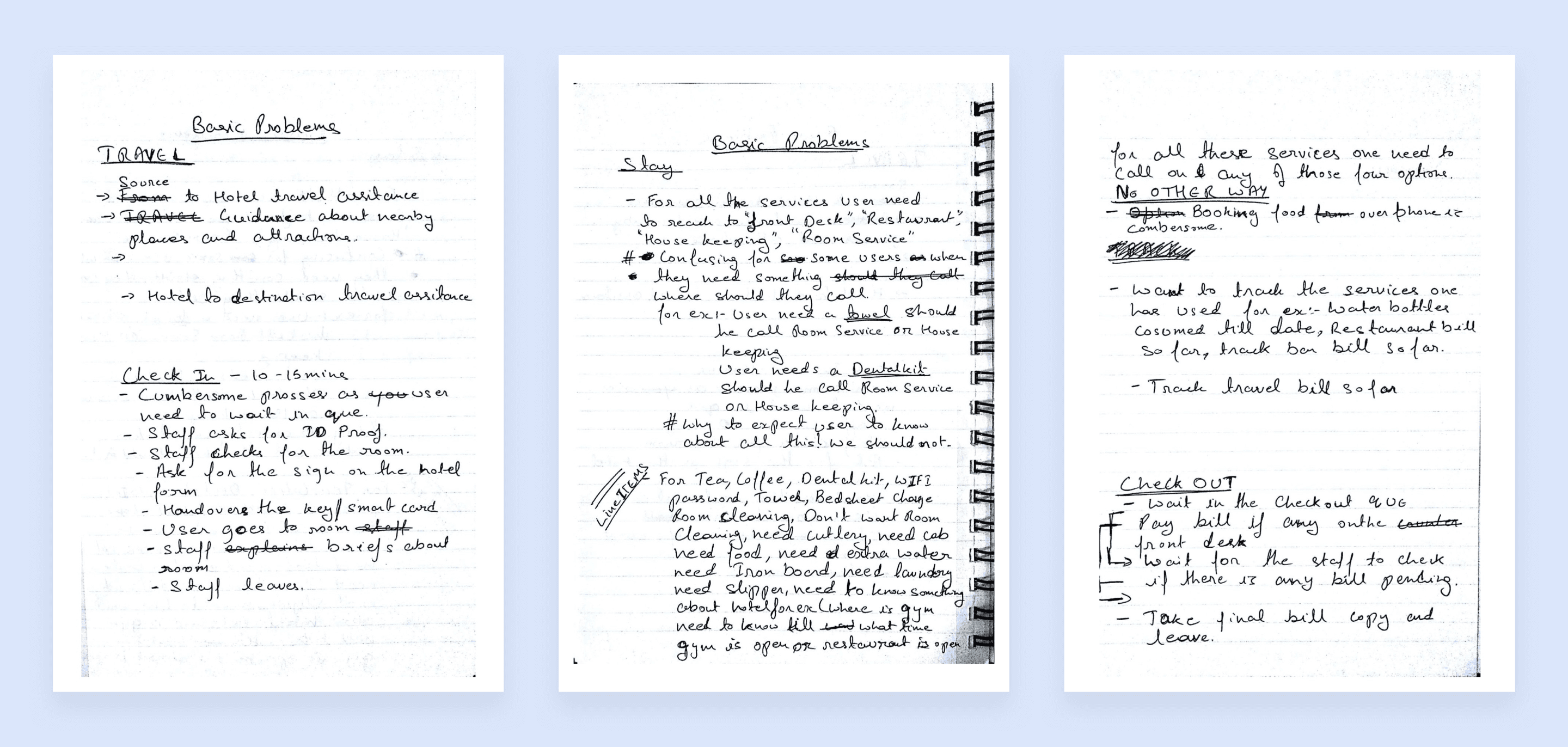
I analyzed user research data using affinity mapping and thematic analysis to categorize and prioritize guest pain points. This structured approach revealed patterns across the user journey and helped me identify root causes, not just symptoms. By organizing problems into distinct, actionable categories, I created a framework that guided both the solution architecture and feature prioritization.

Problem Identification - Categorized Guest Pain Points

Contextual Research

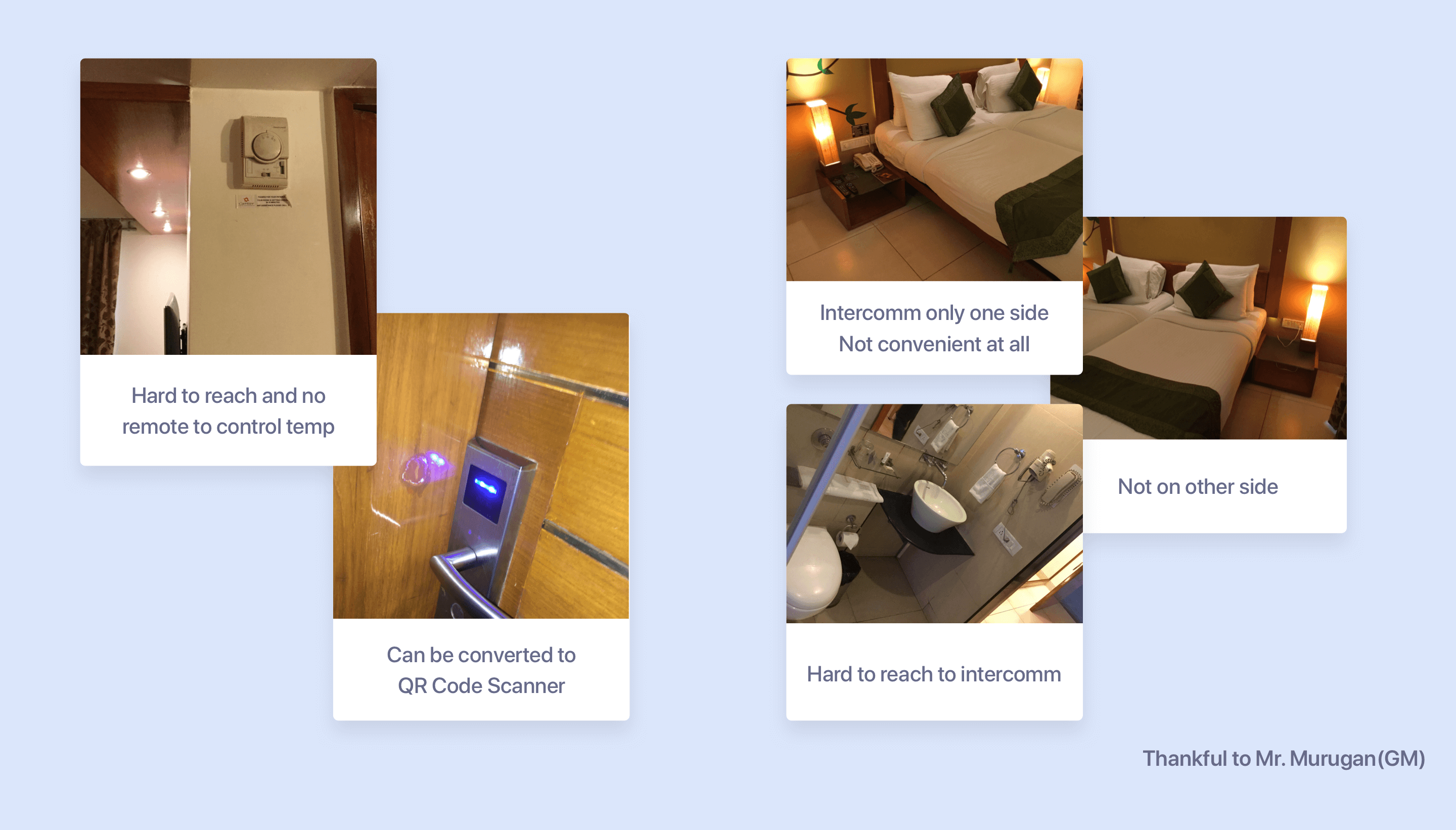
To bridge the gap between what users need and what hotels can actually deliver, I spent time at a budget hotel doing field research. I observed operations directly, interviewed the general manager, and analyzed their workflows. This gave me critical insights into the real challenges hotels face. When I shared my user research findings with the hotel team, we had a collaborative conversation that revealed solutions that work for both guests and operations. This ensured my design decisions were grounded in what's actually feasible.

Contextual Research - Field Study and Stakeholder Insights

Three Key Experience Pillars

After analyzing user journey maps, clustering pain points, and assessing satisfaction impact, I identified three critical experience pillars that became the foundation for the entire solution. These pillars represent the highest-leverage moments in the guest journey. They're the touchpoints where strategic intervention can dramatically improve both how guests feel and what they actually experience, which drives satisfaction and loyalty.

Before Stay

Seamless arrival coordination, transportation booking, and digital check-in preparation

During Stay

Service requests, dining, amenities access, and real-time communication with hotel staff

After Stay

Streamlined check-out, bill management, feedback collection, and departure logistics

Solution Architecture: Four Major Buckets

To create a scalable, maintainable solution architecture, I organized the problem space into four functional domains. Each bucket represents a distinct area of guest interaction with clear boundaries. This enables modular development, independent iteration, and future extensibility. The architecture can evolve with changing user needs and business requirements while keeping the system coherent.

Travel

Transportation booking, navigation assistance, and arrival coordination

Convenience

Room service requests, dining orders, amenities access, and staff communication

Check In / Check Out

Digital check-in, room assignment, key management, and streamlined departure

Tracking

Real-time bill tracking, expense monitoring, and service request status

03

Design

I brought the solution to life through visual design, interaction patterns, and user experience architecture that creates delight while staying functional.

Style Guide & Visual System

I built a comprehensive design system that ensures visual consistency, brand coherence, and scalable components. The system follows atomic design principles, so every interface element from typography and color to spacing and interactions works together across all touchpoints. This systematic approach lets us iterate quickly, maintain quality, and avoid design debt as the product grows.

FONT

Fonts used in project

Aa
SF Pro
ABCČĆDDEFGHIJKLMNOPQRSŠTUVWXYZŽ
abcčćddefghijklmnopqrsštuvwxyzž
1234567890०१२३४५६७८९'?''!"(%) [#]{@}/&<- ++x=>®©$€£¥¢:;,.**

COLORS

All colors used in project

Main CTA
#DF1652
Gradient for main CTA
Positive
#317F0E
Alert
#C47507
Negative
#A01910
White
#FFFFFF

PRIMARY

100
#FDE4D3
200
#FCC3A8
300
#F7987C
400
#EF705A
500
MAIN
#E53427
600
#C41C1E
700
#A41321
800
#840C22
900
#6D0722

GREYS

100
#EFF3FB
200
#E0E7F8
300
#C8D1EB
400
#B0B9D7
500
#8F99BD
600
#6873A2
700
#485388
800
#2D376D
900
#1B235A

ACCENT

100
#D9F7FD
200
#B2EEFA
300
#8CE6F8
400
#6EE0F7
500
#47D7F4
600
#22CFF2
700
#0DBADD
800
#0B9AB7
900
#097A90

Stages of Guest Experience

I organized the guest journey into three distinct phases, each with unique user goals, emotional states, and service requirements. By mapping specific touchpoints and interaction opportunities within each phase, I ensured the application addresses user needs systematically while staying contextually relevant throughout the entire stay.

Before Stay

  • Book cab
  • Hotel check-in
  • Assign room
  • Room Key

During Stay

  • Service requests (water bottle, dental kit, etc.)
  • Direct communication with hotel reception
  • Digital room key access
  • Room dining menu and ordering
  • Hotel amenities information
  • Real-time bill tracking (Dining, Laundry, etc.)
  • Room appliance control

After Stay

  • Online bill clearance for fast check-out
  • Streamlined check-out process
  • Cab booking
  • Stay experience feedback

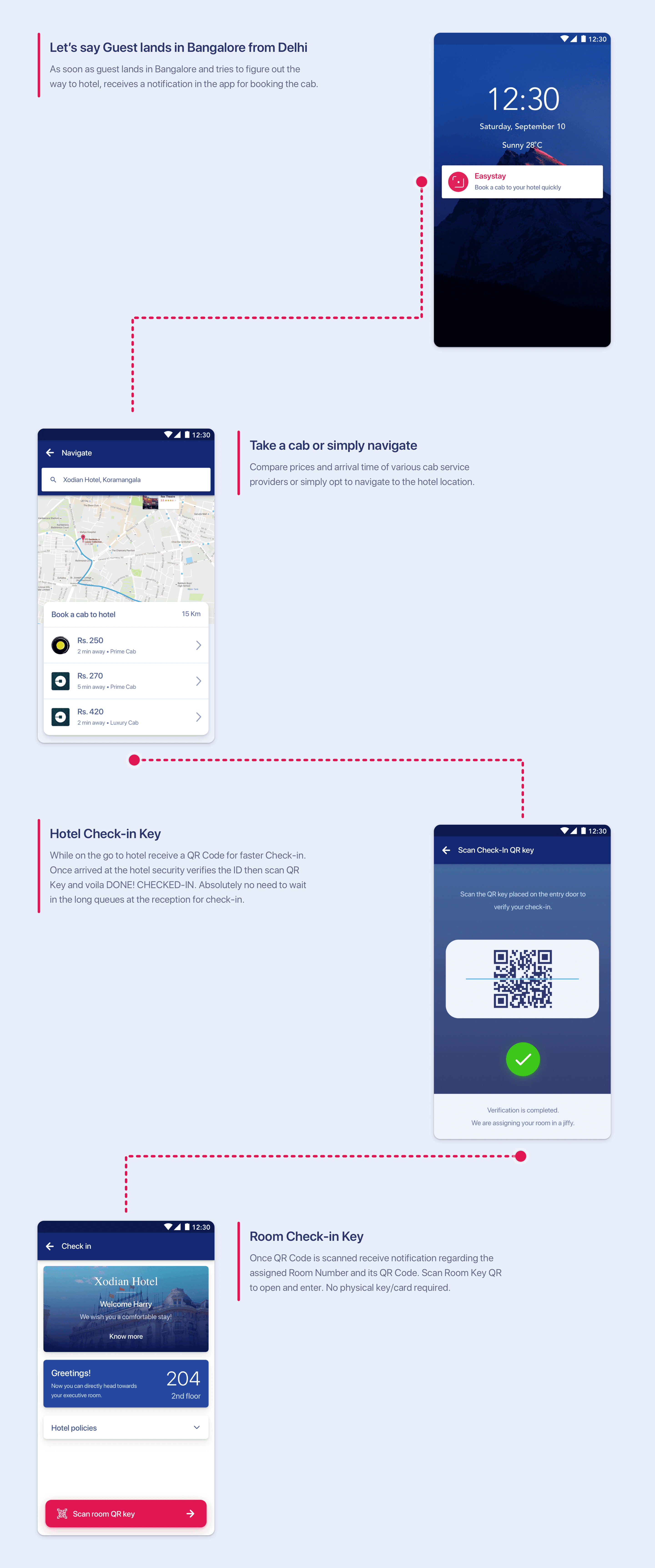
Before Stay: Mockups and User Flow

I designed comprehensive interfaces and interaction flows that guide guests through pre-arrival coordination, including transportation booking, digital check-in preparation, and seamless arrival logistics.

Before Stay - Complete User Flow and Interface Design

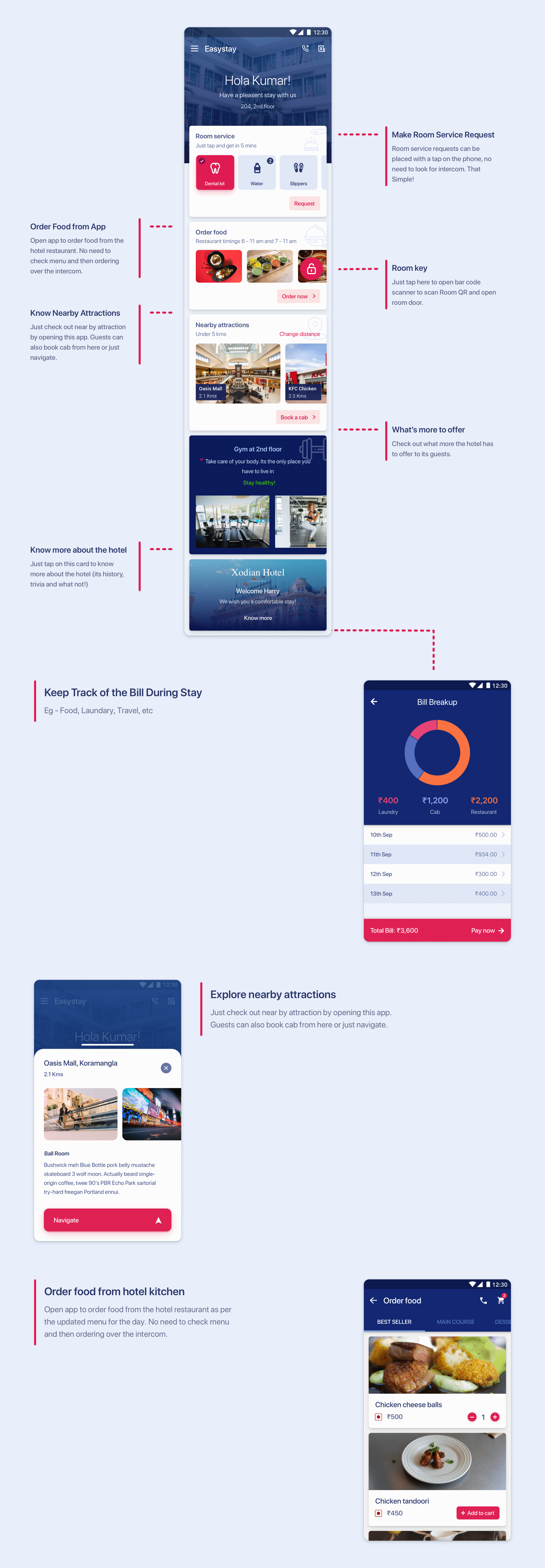
During Stay: Mockups and User Flow

I created detailed interface designs and interaction patterns for the core stay experience, enabling guests to manage service requests, access dining options, explore amenities, track expenses, and maintain seamless communication with hotel staff.

During Stay - Service Request and Amenity Management Flows

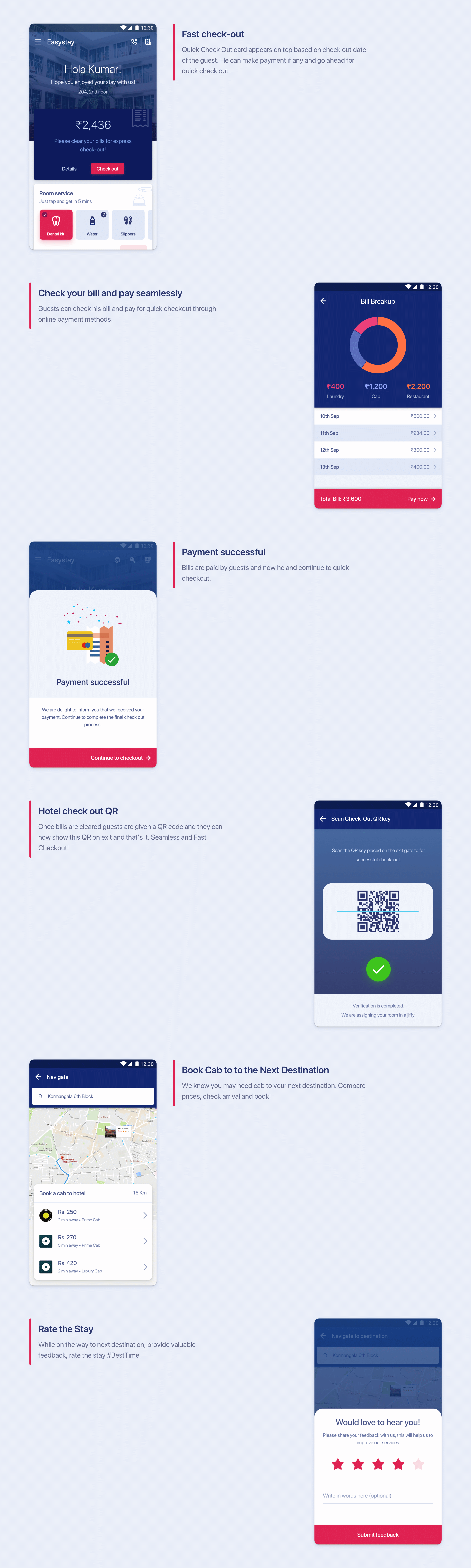
After Stay: Mockups and User Flow

I optimized check-out workflows so guests can review and settle bills digitally, provide feedback, and coordinate departure logistics. This transforms what's usually a time-consuming process into something seamless and efficient.

After Stay - Check-out and Feedback Collection Flow

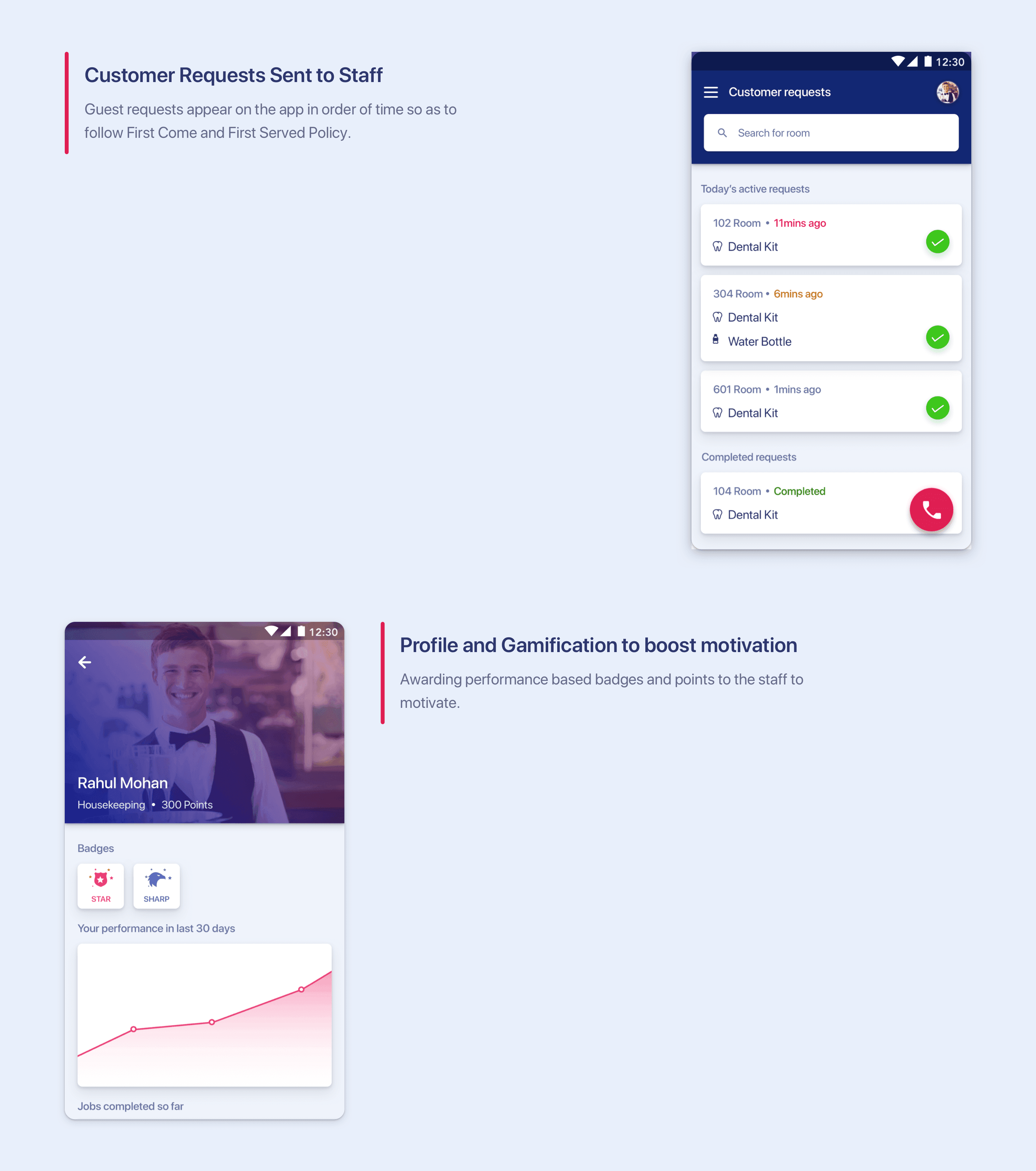
Hotel Staff App: Mockups and Operational Flow

I built a purpose-built interface for hotel staff that helps them manage guest requests, track service fulfillment, maintain quality standards, and optimize resource allocation. It creates a seamless workflow that makes staff more productive and guests more satisfied.

Hotel Staff App - Request Management and Operational Dashboard
04

Conclusion

This project demonstrates how strategic design thinking can transform complex operational challenges into elegant, user-centered solutions that create value for both guests and hotel operators.

The Easystay Hotel App represents a comprehensive approach to solving real problems in the hospitality industry. By focusing on the entire guest journey from pre-arrival to post-departure, I created a unified platform that eliminates friction points and elevates the experience at every touchpoint.

The solution's success comes from understanding both sides of the equation. For guests, it provides convenience, control, and transparency. For hotels, it streamlines operations, reduces overhead, and improves service quality. This dual-benefit approach ensures the product delivers real business value while creating genuine user satisfaction.

Throughout this project, I learned that great product design requires deep empathy for users, rigorous research, and a willingness to challenge assumptions. By spending time in hotels, talking to guests, and understanding operational constraints, I was able to design solutions that work in the real world, not just in theory.

The design system and component architecture I built ensure the product can evolve and scale. As hotels adopt the platform and new needs emerge, the foundation is solid enough to support growth while maintaining design quality and user experience standards.

Key Takeaways

This project reinforced several important principles that guide my design practice:

  • Context matters: Field research and stakeholder conversations revealed insights that desk research alone couldn't provide.
  • Design systems enable speed: A well-structured design system lets teams move faster while maintaining quality and consistency.
  • Solve for both users and business: The best products create value for end users while delivering measurable business outcomes.
  • Architecture enables evolution: Thoughtful information architecture and component design ensure products can grow and adapt over time.